


Frenulum-Sparing Circumcision in Istanbul, Turkey
Frenulum-Sparing Circumcision in Istanbul, Turkey
Frenulum-sparing circumcision removes the foreskin while intentionally preserving the sensitive penile frenulum and its blood supply. Dr. Tuncay Tas explains when preservation makes sense.
Table of Contents
What Is the Penile Frenulum?
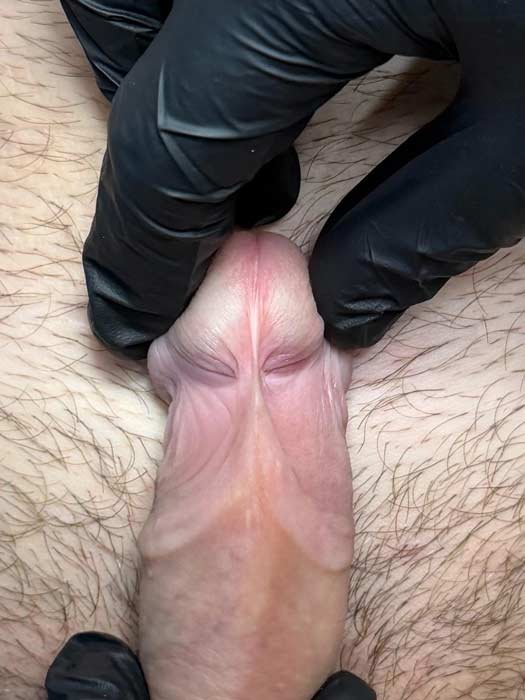
The penile frenulum sits on the underside of the glans, connecting the inner foreskin to the ventral surface of the glans before circumcision. Many patients compare it to the small tissue fold beneath the tongue, though the penile frenulum carries its own distinct anatomy and function.
This tissue does far more than anchor the foreskin in place. Sensory nerves, small blood vessels, mucosa and penile skin all converge in this specific region.
Research into penile innervation shows that the frenulum receives sensory input through more than one neural pathway, including branches of the dorsal penile nerve and the perineal nerve. This dual sensory supply helps explain why many men describe the ventral glans and frenular region as unusually sensitive.
Frenulum-sparing circumcision, also called frenulum-preserving circumcision, treats this anatomy as worth protecting. Rather than routinely dividing the frenulum while removing the foreskin, the surgeon plans the incision around it, preserving the frenular tissue and its underlying blood vessels whenever the patient's anatomy allows it.
Is the Frenulum One of the Most Sensitive Areas of the Penis?
Several anatomical and physiological studies point toward a genuinely special sensory role for this region. One tissue study found a significantly higher density of sensory nerve markers in the preputial frenulum than in nearby foreskin samples. A more recent, detailed 2025 immunohistological study described particularly high neural density in what researchers termed the frenular delta, characterizing it as a specialized center of penile sexual sensation.
Functional evidence supports this too. A 2022 psychophysical and functional MRI study investigating pleasant genital sensation found that stimulation of the frenulum produced the highest subjective pleasure ratings among the penile regions tested, alongside distinct brain responses.
It would overstate the evidence to call the frenulum unquestionably the single most sensitive spot on every man's penis. Sensitivity varies considerably between individuals. Still, these findings support a simple principle: the frenulum carries rich innervation and deserves deliberate consideration whenever a patient plans circumcision.
How Frenulum-Sparing Circumcision Works
A frenulum-sparing circumcision removes the desired amount of foreskin while the surgeon avoids routinely cutting through the frenulum. This differs from many conventional circumcision techniques, where the frenulum sits directly inside the circumferential incision and comes away with the foreskin by default.
A published surgical series describing this technique treated 42 patients between four and 64 years of age. The surgeons preserved a skin and mucosal bridge around the frenulum and reported no major frenular bleeding, painful postoperative erections, chordee, meatal stenosis or urethrocutaneous fistula during follow-up, with satisfactory cosmetic outcomes.
That series stayed small, and its authors themselves called for larger randomized studies before claiming superiority over established techniques. Frenulum preservation carries a genuine anatomical rationale, but responsible medicine still separates that rationale from proven long-term clinical superiority. The evidence supports offering preservation as a thoughtful option, not treating it as mandatory for every patient.
Why Choose Frenulum-Sparing Circumcision?
Several distinct reasons support preservation when the anatomy allows it.
Sensory preservation. If a structure does not need removal for medical reasons, a tissue-preserving philosophy asks a fair question: why intentionally sacrifice functional, sensitive tissue? This matters most in adult cosmetic circumcision, where patients want a specific appearance while keeping normal anatomy intact.
Protecting the frenular artery. The frenulum carries its own vascular supply through terminal and circumflex penile arterial branches, and paired vessels sometimes run through the frenular bed. Dividing the frenulum can expose these vessels and create a genuine bleeding risk.
In the 42-patient series above, surgeons never encountered the frenular artery and reported no significant frenular bleeding, meaning one important ventral vascular structure stayed undisturbed throughout the case.
Avoiding an extra ventral scar. Dividing the frenulum often calls for reconstruction or suturing across the ventral surface, adding a scar beneath the glans. Skipping that step, when the anatomy allows it, removes the need for that additional repair.
The 42-patient series proposed that avoiding a suture line across a transected frenulum could reduce painful postoperative erections, and the series recorded none.
Respecting natural ventral anatomy. The frenulum forms a natural connection between the ventral glans and the surrounding penile skin. Removing too much ventral skin can occasionally create tension during erection, including painful ventral curvature or upward displacement of scrotal skin in severe cases.
The dorsal and ventral surfaces of the penis differ anatomically, so a well-planned circumcision line should respect that difference rather than tracing an identical circle around every patient.
Why Standard Circumcision Often Cuts the Frenulum
Patients often ask why surgeons divide the frenulum so routinely if it carries real sensation. Most conventional circumcision techniques evolved around circumferential foreskin removal, and the frenular attachment simply falls inside that surgical plane by default. Dividing it can also make it easier to align mucosal and shaft-skin edges into a uniform circumferential wound, which simplifies the procedure from a purely geometric standpoint.
That efficiency does not mean every anatomical area benefits from identical treatment. A perfectly circular scar is not the only surgical priority, and preserving functional anatomy can justify adapting the incision on the ventral side.
Sometimes the frenulum itself is abnormal to begin with. A frenulum breve, an unusually short frenulum, can pull the glans downward during erection, cause pain or tear repeatedly during intercourse.
Simply preserving a frenulum like this unchanged would perpetuate the existing problem, so these patients typically need a frenuloplasty instead, which lengthens or reconstructs the tissue rather than removing it. For a detailed look at that specific procedure, see our guide to circumcision revision surgery, including frenuloplasty.
When Frenulum-Sparing Circumcision Is Not Appropriate
Preservation does not suit every patient. Dr. Tas typically rules it out when the exam reveals:
- Significant frenulum breve or a genuinely short, restrictive frenulum
- Severe frenular scarring or previous traumatic injury
- Active inflammatory disease involving the frenulum
- Extensive lichen sclerosus or balanitis xerotica obliterans
- Suspicious penile lesions requiring further evaluation
- Anatomical distortion left by previous surgery
The original 42-patient frenulum-sparing series excluded patients with a short or scarred frenulum and those with severe inflammatory foreskin disease for the same reason. Preservation should stay selective and anatomical, not automatic.
A healthy, functional frenulum makes a reasonable candidate for preservation. A diseased, scarred or pathologically short one usually needs treatment instead, most often frenuloplasty.
Frenulum-Sparing Circumcision and Sexual Function
Removing a sensory structure necessarily removes the nerve endings inside that specific tissue, and the frenulum genuinely carries substantial innervation. That said, multiple systematic reviews comparing circumcised and uncircumcised men have not demonstrated consistent overall deterioration in erectile function, orgasm or sexual satisfaction after circumcision generally.
These two facts sit together without contradiction. The penis contains multiple sensory regions and several neural pathways, so a man can lose or modify one local sensory structure without developing measurable global sexual dysfunction.
At the same time, an adult patient may reasonably prefer to keep a naturally sensitive structure intact when removal serves no medical purpose. That preference sits at the center of why frenulum-sparing circumcision exists.
Premature ejaculation deserves a separate answer. One study specifically examined circumcised men and found no statistically significant relationship between an intact frenular web and premature ejaculation, and larger analyses have not established circumcision status as a reliable cause or treatment for it. Premature ejaculation involves neurological, psychological and physiological factors together, so neither removing the frenulum to reduce sensitivity nor preserving it to influence timing has solid evidence behind it as a predictable strategy.
Combining Frenulum-Sparing Circumcision With Your Preferred Style
High versus low and tight versus loose describe the position of the circumcision line and how much skin mobility remains. Frenulum-sparing describes how the surgeon treats the ventral frenular region specifically. These describe two different aspects of the same operation, so a patient can potentially combine any style with frenulum preservation, including high and tight, high and loose, low and tight, or low and loose.
The exact amount of inner mucosa and shaft skin that can safely remain still differs from patient to patient, so Dr. Tas assesses your anatomy before confirming which combination fits. He will never perform an aggressively tight circumcision purely to match a reference photo if doing so would create inappropriate tension around the ventral penis or frenulum. Anatomy always takes priority over a specific look. You can review verified before and after photos from Dr. Tas's own patients.
Dr. Tas has also published research specifically examining circumcision scar wrinkling and the role of hemostasis and suturing technique, reflecting a broader principle: how a surgeon handles tissue matters just as much cosmetically as how much tissue he removes. Frenulum-sparing circumcision extends that same principle to the ventral anatomy of the penis.
How Much Does Adult Circumcision Cost in Turkey?
Adult circumcision at SafeFill Clinic in Istanbul typically costs $1,000 to $2,000. Where a specific case falls in that range depends on whether it is a straightforward first-time circumcision or a technically demanding one, and on whether the procedure runs under local or general anaesthesia.
The table below sets that range next to typical self-pay prices abroad for a surgeon-performed procedure in an accredited hospital setting, with consultation and follow-up included. Walk-in clinic prices under local anaesthesia can be lower in every country, so compare what each quote actually covers rather than the headline number alone.
| Where | Typical adult circumcision cost | What usually drives the price |
|---|---|---|
| Turkey (SafeFill Clinic, Istanbul) | $1,000 to $2,000 | Anaesthesia type and case complexity |
| United Kingdom | £1,500 to £3,000 | Day clinic versus private hospital under general anaesthesia |
| United States | $1,500 to $4,500 | Facility fee, anaesthesia, and surgeon fee often billed separately |
Swipe the table sideways on mobile to see every column.
These figures describe typical market ranges rather than a fixed quote. Your own number follows from your examination, so ask for a written breakdown that states exactly what the price covers, including anaesthesia, hospital stay, medication, and follow-up, before you commit to any clinic.

Assoc. Prof. Dr. Tuncay Tas
Board-Certified Urologist based in Istanbul, with more than 20,000 circumcision procedures performed during his surgical career. Dr. Tas evaluates the frenulum before every circumcision rather than assuming surgeons must always remove or always preserve it.
If it looks healthy and fits the technique he has planned, he preserves it. If it shows frenulum breve, scarring or another pathological finding, he plans an individualized frenuloplasty or corrective procedure instead. The objective stays the same for every patient: remove what needs removal, and preserve what does not need sacrifice.
Frequently Asked Questions
Does circumcision require removal of the frenulum?
Why do many circumcision techniques divide the frenulum?
Is the frenulum an erogenous area?
Will preserving my frenulum guarantee more sexual pleasure?
Does removing the frenulum always cause sexual dysfunction?
What if I already have a short frenulum?
Can I combine frenulum preservation with a high and tight style?
How experienced is Dr. Tas with circumcision surgery?
Send Us a Message
Ready to Discuss Frenulum-Sparing Circumcision?
Book a confidential consultation with Assoc. Prof. Dr. Tuncay Tas in Istanbul.