Congenital Penile Curvature: Causes and Surgical Correction
A clear guide to congenital penile curvature, how it differs from Peyronie's disease, and how penile plication corrects it, from Dr. Tuncay Tas.
Table of Contents
What Is Congenital Penile Curvature?
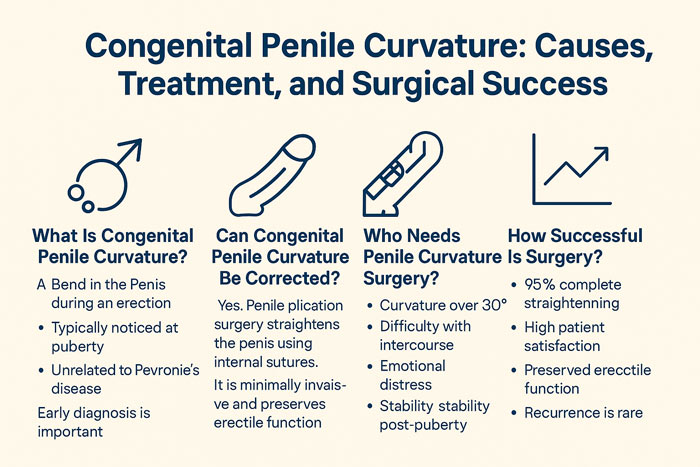
Congenital penile curvature means the penis bends during an erection due to how it developed before birth. Unlike an injury-related condition, no scar tissue causes the bend. Instead, one side of the shaft simply grew a little differently than the other, and this small difference becomes obvious only once the tissue fills with blood.
The curve typically becomes noticeable at puberty, once regular erections begin. Mild cases, under 30 degrees, rarely cause problems and often need no treatment at all. More significant curves, however, can affect comfort and confidence during intercourse. For this reason, many men wait years before seeking an opinion, even though a straightforward evaluation could clarify their options much sooner.
Curvature can point in any direction, upward, downward, or to either side, and the direction itself does not indicate severity. Some men also notice a slight narrowing at the point of curvature, sometimes described as an hourglass shape, which forms alongside the bend rather than as a separate condition.
Causes and How Common It Is
The condition traces back to uneven tissue development inside the tunica albuginea, the fibrous layer surrounding the erectile chambers. Specifically, one side simply develops slightly longer than the other, and this imbalance creates a bend that becomes visible with erections. Researchers do not fully understand why this uneven growth happens in any specific case.
Research shows, in addition, that some degree of penile curvature affects roughly 4% to 10% of men. It sometimes occurs alongside other congenital conditions, including hypospadias and irregular foreskin development. Importantly, the curve itself does not worsen over time. Equally, it will not correct itself without treatment, so an untreated curve today looks essentially the same years later.
Because the condition has no clear single cause, no lifestyle factor, medication, or activity during pregnancy explains it. Parents and patients alike sometimes search for a preventable cause, but the honest answer is that this variation in development happens naturally and unpredictably, similar to other minor anatomical differences that show up across the general population.
What Causes Penile Curvature? Congenital vs. Acquired
Many men who search for the causes of penile curvature do not yet know which type they have, and the answer changes the treatment completely. Curvature falls into two broad groups. Congenital curvature comes from uneven growth of the tunica albuginea before birth, so it exists from the first erections of puberty. Acquired curvature develops later in life, and the most common cause is Peyronie's disease, in which a scar plaque forms inside the tunica after repeated micro-injury.
| Feature | Congenital curvature | Peyronie's disease | Other acquired causes |
|---|---|---|---|
| Underlying cause | Asymmetric tunica development | Fibrous plaque from micro-trauma | Penile fracture, prior surgery, hypospadias repair |
| When it appears | Puberty, first erections | Usually after 40 | After the injury or operation |
| Pain | None | Common in the active phase | Depends on the injury |
| Palpable lump | No | Yes, a plaque | Sometimes scar tissue |
| Course over time | Stable | Progresses for 12 to 18 months, then stabilizes | Usually stable once healed |
| Usual correction | Plication | Plication, grafting, or implant | Case by case |
Ventral (downward) and lateral bends are the classic congenital patterns, while a new upward or sideways bend in a man over 40 points toward Peyronie's disease. If your curvature appeared recently, started with pain, or came with a lump you can feel, read our guide to Peyronie's disease symptoms and treatment. Men with a stable Peyronie's curve who are already weighing surgery can compare techniques in our Peyronie's disease surgery guide.
How This Differs From Peyronie's Disease
Patients often confuse the two conditions, but they have distinct origins. Congenital curvature is present from birth or puberty and involves no scar tissue whatsoever. Peyronie's disease, in contrast, develops later in life, usually from a scar-forming plaque that follows minor injury to the penis.
This distinction matters clinically. Non-surgical Peyronie's treatments, such as enzyme injections or traction therapy, do not work for congenital curvature, since there is no plaque to target. For a full comparison of Peyronie's treatment options, see our Peyronie's Disease Treatment guide.
Who Actually Needs Congenital Penile Curvature Surgery?
Surgery becomes a reasonable option under a few specific circumstances. The curvature exceeds 30 degrees, sexual intercourse becomes difficult or painful, or the condition causes real emotional distress. Doctors also generally wait until the curve has stabilized after puberty before recommending correction.
To confirm severity, Dr. Tas may use Doppler ultrasound or an artificial erection test during evaluation. This precise measurement, rather than guesswork, determines whether surgery truly makes sense.
Penile Plication for Congenital Penile Curvature
Surgical correction remains the only effective treatment for congenital curvature, and penile plication is the standard technique. This outpatient procedure places internal stitches on the longer side of the shaft, which balances the two sides and straightens the erection.
Crucially, plication removes no erectile tissue. This preserves normal erectile function while correcting the curve. The procedure works for both circumcised and uncircumcised patients, and Dr. Tas performs it under general or spinal anesthesia depending on your case.
During the procedure, Dr. Tas first induces an artificial erection to precisely map the exact degree and direction of curvature. This step matters, since placing sutures based on a flaccid measurement could produce an inaccurate correction. Only once he confirms straightening intraoperatively does he close the incision, which is why plication delivers such consistent, reliable results.
Success Rate and What to Expect
| Outcome Measure | Typical Result |
|---|---|
| Straightening success rate | Approximately 95% |
| Erectile function | Preserved, no tissue removed |
| Length change | Slight reduction possible, rarely noticeable |
| Hospital stay | Same day or one night |
Most patients report high satisfaction after plication. On rare occasions, patients feel sutures beneath the skin, particularly with non-absorbable materials. Absorbable sutures feel more comfortable, though they carry a slightly higher chance of the curve partially returning.
Dr. Tas discusses this specific trade-off during consultation, since the right suture choice depends on your priorities. Patients focused on minimizing any sensation of the repair often prefer absorbable material, while those most concerned about the curve returning may prefer the added durability of non-absorbable sutures instead.
Recovery Timeline
- Light activities resume within 2 to 3 days.
- Sexual activity waits 4 to 6 weeks, until the tissue fully heals.
- Mild swelling or soreness during healing is normal.
- Once healed, no further treatment or maintenance is needed.
Avoiding sexual activity and physical trauma until full recovery protects the surgical result. Beyond this window, patients typically resume normal life without restriction.
Most men also return to work within a few days, though jobs involving heavy physical strain may warrant a longer break. Dr. Tas provides specific guidance based on your occupation and overall healing progress during follow-up.
Follow-up appointments confirm the correction holds as expected. For international patients, this typically means a video consultation once you return home, supplementing the in-person check before departure, so recovery stays properly monitored throughout.
Cost in Istanbul
At SafeFill Clinic, penile curvature correction costs between $3,000 and $4,500 USD. This price includes the pre-operative consultation, surgery under general or spinal anesthesia, same-day discharge or a one-night hospital stay, and full post-operative follow-up care.
For international patients, we also coordinate airport transfers and hotel accommodations, so your entire treatment journey stays organized from arrival to departure. Most patients plan a total trip of five to seven days, covering consultation, surgery, and a brief recovery period before flying home.
The Emotional Side of Congenital Penile Curvature
Congenital penile curvature is not dangerous, and it does not affect fertility. Still, it can quietly affect confidence. Many men describe performance anxiety, lower self-esteem, or worry about a partner's comfort during intercourse, even when the curve itself is mild.
These feelings are common, and they are valid reasons to seek treatment on their own, separate from any physical difficulty. Surgical correction addresses both sides of the issue at once, resolving the physical bend while also relieving the anxiety that often surrounds it.
Many patients also worry unnecessarily about how a partner will react to the discovery of curvature before treatment. In practice, most partners respond with understanding rather than concern, particularly once they learn how common and treatable this condition actually is in general.

Assoc. Prof. Dr. Tuncay Tas
Board-Certified Urologist & Male Sexual Health Specialist, based in Istanbul. Dr. Tas has treated many patients with congenital penile curvature using precise, function-preserving plication technique, and reviews every case personally before recommending surgery or any specific approach.
Frequently Asked Questions
Will the curve disappear on its own?
Will I lose length after surgery?
Is the surgery painful?
Can uncircumcised men have this surgery?
How common is penile curvature?
Does congenital curvature affect fertility?
Is it normal to feel self-conscious about this?
How long should I plan to stay in Istanbul?
What causes penile curvature in adults?
How do I know if my curvature is congenital or Peyronie's disease?
Send Us a Message
Ready to Discuss Congenital Penile Curvature Correction?
Book a confidential consultation with Assoc. Prof. Dr. Tuncay Tas in Istanbul.